Philip Lamb public art Union Station Dallas Area Rapid Transit

In 1994, Mr. Lamb received a commission from DART to design and produce 12 murals to be displayed in wind screens on the light rail platform of the Union Station light rail platform, downtown Dallas. They are each 4 by 5 feet in size, and are executed in terrazzo.

Please scroll the page for images and descriptions
of the panels.
Panel One

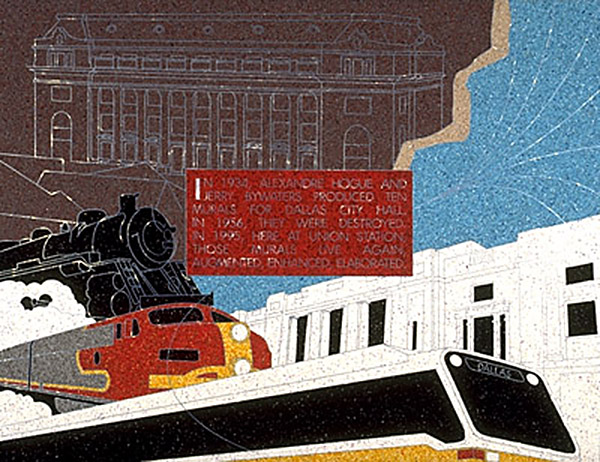
This panel serves, in part, as a "legend" for the eleven other murals. It establishes a visual format in which past information, depicted in monochrome, is embellished and expanded with more recent information, shown in color. In each panel, the monochrome layer gives the illusion of "breaking away" to reveal a second image behind it. This dual format is combined with a third layer, a red rectangle in the center of each mural. The rectangles contain quotations that enrich the visual imagery.

The first panel explains the project's genesis. In 1934, Alexandre Hogue and Jerry Bywaters, two respected and accomplished Texas artists, painted ten murals in the old Dallas City Hall. The murals were destroyed in 1954 when the building was renovated and expanded. 

The next ten murals each depict Philip Lamb's interpretation of one of the Hogue/Bywaters murals, shown in monochrome, and are augmented with Mr. Lamb's full-color images that relate to the original mural subjects. The twelfth and final panel is a summation of the project. 

The monochrome drawing of Panel One depicts Dallas City Hall circa 1934. Below and to the right is a color representation of Union Station in 1995. To the left are three trains representing three generations of rail transportation in Dallas -- a steam engine, a diesel engine, and a DART light rail car. In the sky shown in the upper-right of the piece, seven lines converge into one that winds through the center of the image and overlaps the trains. This represents the function of Union Station when it opened in the early 1900's, to unite seven separate passenger rail stations into one. Symbolically, it represents the union of the Hogue/Bywaters murals with the updated imagery. The quote in this panel reads: "In 1934, Alexandre Hogue and Jerry Bywaters produced ten murals for Dallas City Hall. In 1956, they were destroyed. In 1995, here at Union Station, those murals live again, augmented, enhanced, elaborated." 
Panel Two

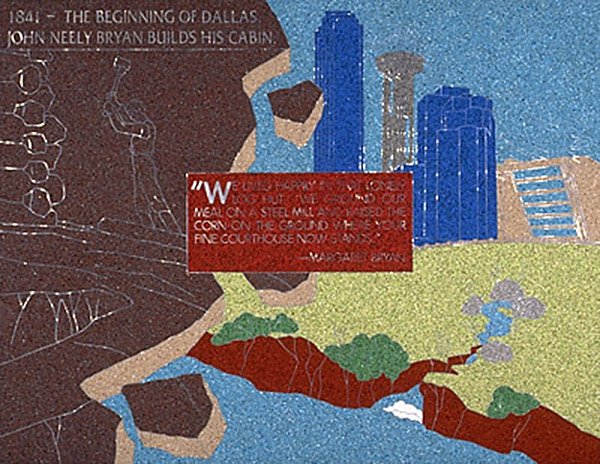
The Hogue/Bywaters mural shows John Neely Bryan, the founder of Dallas, building his log cabin. The original cabin remains preserved in downtown but at a different site. The title above is the same as the one used on the original mural: "1841 - The beginning of Dallas. John Neely Bryan builds his cabin." (All the following Hogue/Bywaters murals also have titles.) Revealed behind the monochrome depiction is downtown Dallas circa 1995, showing the tallest building (NationsBank Tower), the Hyatt Regency Hotel and ReUnion Tower, and City Hall. On a whimsical note, the large coffee cup hovering over City Hall refers to John Neely Bryan's son Coffee, who died as an infant. Bryan's cabin was located next to a spring seeping from a bluff on the Trinity River. Even after levees were constructed in the 1930's, historical accounts indicate that the spring continued to flow. There is no evidence of it now. The quote in the center of the image is from Margaret Bryan, John Neely's wife: "We lived happily in that lonely log hut. We ground our meal on a steel mill and raised the corn on the ground where your fine courthouse now stands."
Panel Three

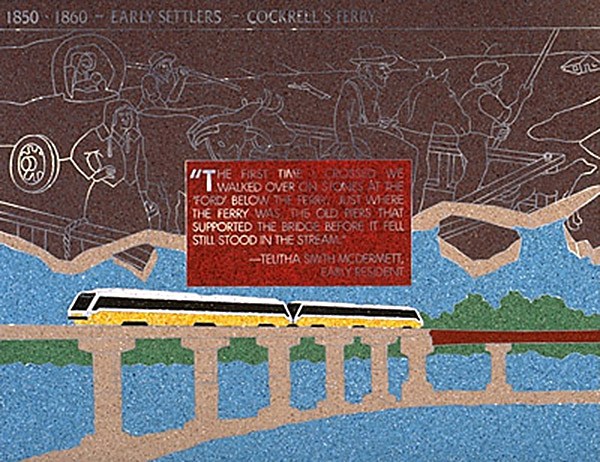
The top half of this panel shows the Hogue/Bywaters mural of a commercial venture for crossing the Trinity River, Cockrell's Ferry. The title reads: "1850 - 1860 - Early Settlers - Cockrell's Ferry." The ferry was operated by Sarah Cockrell after the death of her husband. The artwork shows the Trinity River in a flooded state. Below the old mural, the new imagery shows the latest commercial crossing of the Trinity, the DART light rail bridge connecting Oak Cliff to downtown Dallas. The river is also shown flooded. The quote, from early Dallas resident Telitha Smith McDermett, also relates to crossing the river: "The first time I crossed we walked over on stones at the 'ford' below the ferry. Just where the ferry was, the old piers that supported the bridge before it fell still stood in the stream." This refers to an original bridge that collapsed, necessitating use of the ferry.
Panel Four

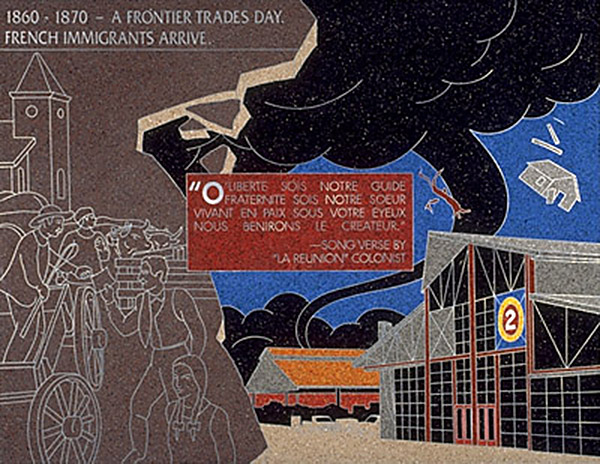
The Hogue/Bywaters mural shown in this panel refers to the La Reunion colony of French settlers that attempted an utopian community in the Dallas area. The image portrays a trade-day where the French settlers are exchanging goods with other area residents. The title reads: "1860 - 1870 - A Frontier Trades Day. French Immigrants Arrive." This utopian village, located approximately at where Highway 80 and Loop 12 intersect (it resembled their part of France) unfortunately failed. The crops were planted in infertile and rocky soil and fell victim to the now famous Texas summers. There were also disputes among the colonists. A parallel to this disaster is represented by the tornado in the background to the right, symbolizing the major tornadoes in the 1950's (Oak Cliff) and 1980's (Lancaster). The foreground shows the present-day Dallas trade area -- Farmers Market -- looking to the south (toward Oak Cliff and Lancaster). The quote in the center reads "O'liberte sois notre guide, fraternite soir notre soeur, vivant en paix sous votre eyeux, nous benirons le createur." Translated from a La Reunion song verse, it says "Liberty be our guide, friendship be our sister, live in peace in your eyes, our benevolent creator." Incidentally, the commercial development built in the late 1970's surrounding Union Station, ReUnion, was named in reference to this French colony.
Panel Five

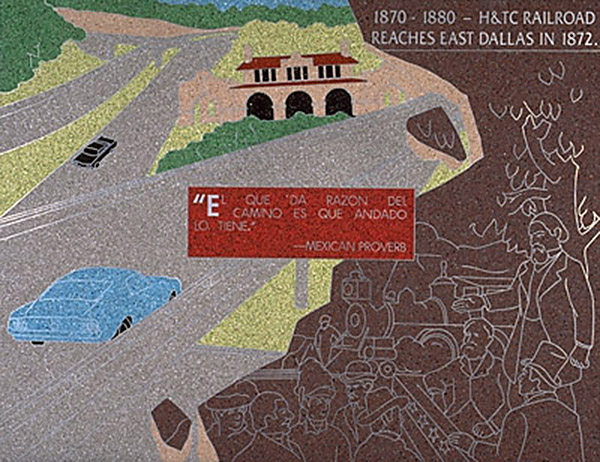
The monochrome portion depicts the dedication ceremony for the arrival of the first passenger train in Dallas, in 1872. The man seated to the left of the orator is an aged John Neely Bryan, the founder of Dallas. The station was near the Deep Ellum section of Dallas, where Central Expressway now passes through. Central Expressway was constructed in the late 1940's on this railroad access. At the time, the station's location was considered to be quite a distance from downtown Dallas. The mural title reads "1870 - 1880 - H&TC railroad reaches East Dallas in 1872."

The color mural on the left shows Dallas North Tollway, another important transit route in Dallas history. Its first phase was completed in the late 1960's. An unintended consequence of its construction was the cleaving in two of the historic section of town called "Little Mexico." Little Mexico was already losing much of its importance as a community as Hispanics assimilated into all of Dallas. Construction of the Tollway was considered the death knell for the neighborhood. The heart of Little Mexico is Pikes Park, the centerpiece of which is a handsome arched building. In the mural, the building represents Little Mexico as wedged between the roadways of the Tollway. The building is shown as it was originally constructed. The quote: "El que da razon del camino es que andado lo tiene," is a Mexican proverb in an antiquated form of Spanish. It translates to: "He who travels the road knows it best." This translation is from a book of quotations in the Dallas Public Library, and its accuracy is questioned by some observers.
Panel Six

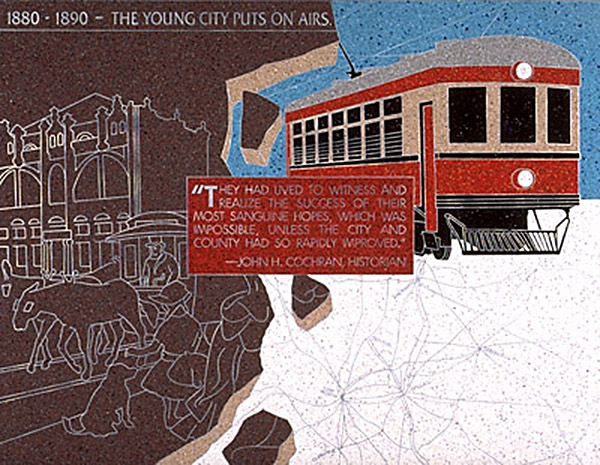
The Hogue/Bywaters mural on the left pictures the young and prosperous Dallas of the 1880's. The first Dallas City Hall is shown in the background. It was an elaborate brick structure. In the foreground is Dallas' first mass transit -- a mule-drawn trolley on tracks. The original mural is entitled "1880 - 1890 - The young city puts on airs."

Juxtaposed with this is an Interurban car from the system that operated in the Dallas area until the early 1950's, when the automobile became prevalent. During the Interurban heyday, one could catch a trolley in Downtown Dallas and go all the way to Sherman, Texas, for example. The system extended in all directions, covering many, many miles. It was the last rail system in Dallas until the present DART light rail system. The map below the Interurban car comes from the magazine of the Dallas Chamber of Commerce, published in the 1920's, and shows the elaborate extent of passenger rail routes at that time. The quote, from Dallas historian John H. Cochran, reads: "They had lived to witness and realize the success of their most sanguine hopes, which was impossible, unless the city and county had so rapidly improved."
Panel Seven

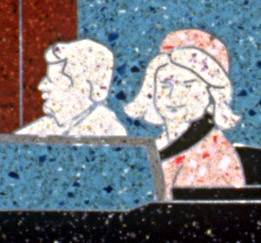
This panel is about the darkest day in the history of Dallas -- the assassination of President John F. Kennedy. On first observing this artwork, one struggles to see the connection of the old mural to the new information.

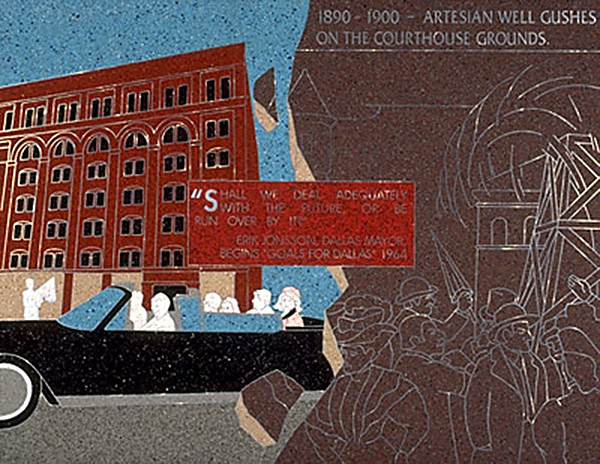
The Hogue/Bywaters mural, entitled "1890 - 1900 - Artesian well gushes on the courthouse grounds," shows a water well shooting a geyser. A man holds an umbrella upright. The assassination scene also shows a man raising an umbrella -- the famous "Umbrella Man" linked to the assassination by many conspiracy theories. Before hearing the Umbrella Man's testimony to the Senate Select Committee investigating the assassination, theorists assumed his raising of the umbrella was a signal to the gunmen. In fact, it was the man's personal protest of a particular Kennedy Administration policy. Artist Philip Lamb is depicted as the Umbrella Man in this mural. The assassination scene shows the motorcade just after it turned from Houston Street onto Elm, and in front of the now infamous Texas Schoolbook Depository.

The detail shows President and Mrs. Kennedy, close to actual size in the mural.

The quote, "Shall we deal adequately with the future or be run over by it," is attributed to then Mayor Erik Johnsson. It was drawn from a speech Mayor Johnsson made outlining his urban planning program called "Goals for Dallas." This initiative was a direct reaction to the negative publicity and damaged self-image of Dallas following the assassination. Goals for Dallas proposed civic projects for the future, among them the Dallas/Fort Worth International Airport.
Panel Eight

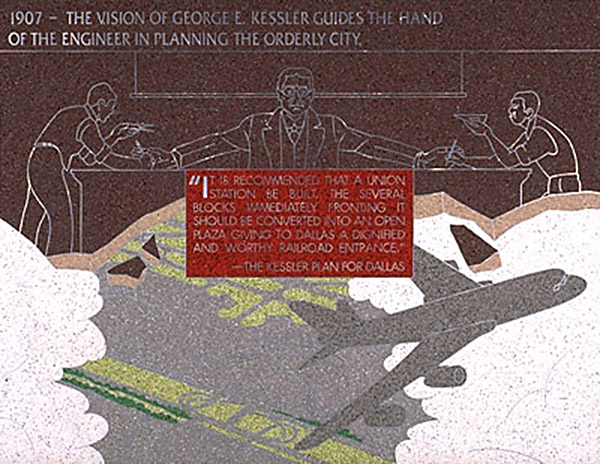
This mural, dated 1907, was a tribute to George Kessler, an early city planner. With a heading "1907 - The vision of George E. Kessler guides the hand of the engineer in planning the orderly city," the artists dedicated this work to "The Kessler Plan," one of the first master plans for the City of Dallas. It was within his plan that Kessler recommended Union Station be built. In addition, the Turtle Creek corridor was his idea, as much for flood control as it was for beautification. Kessler Park in Oak Cliff bears his name. The quote comes from the Kessler plan: "It is recommended that a Union Station be built. The several blocks immediately fronting it should be converted into an open plaza, giving to Dallas a dignified and worthy railroad entrance." That plaza is the existing Ferris Plaza.

The image in color shows Dallas/Fort Worth International Airport, yet another major transportation gateway recommended within a city plan, the "Goals for Dallas" of the 1960's.
Panel Nine

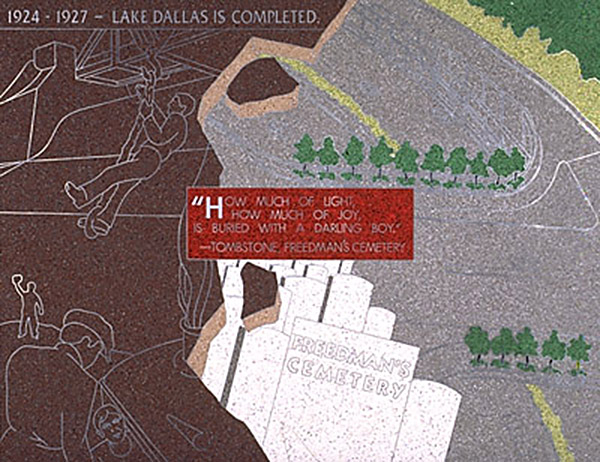
The mural on the left was the eighth in the Hogue/Bywaters series in City Hall. It commemorated of the construction of the dam for Lake Dallas. Lake Dallas then augmented White Rock Lake as a drinking water source for the city. It was titled "1924 - 1927 - Lake Dallas is completed."

To the right, the present-day is represented with what is also a major public works project -- the reconstruction of North Central Expressway. As represented in the lower center, during construction it was discovered that the old freeway and part of Lemmon Avenue covered Freedman's Cemetery, an African-American burial ground. Over a thousand citizens were discovered to be interred in that cemetery. The construction of this part of the freeway became a major political issue, resulting in a painstaking archeological excavation of the site and reinterment of the remains. A major public art project was commissioned for the site. The quote comes from one of only two tombstones discovered during the excavation: "How much of light, how much of joy, is buried with a darling boy."
Panel Ten

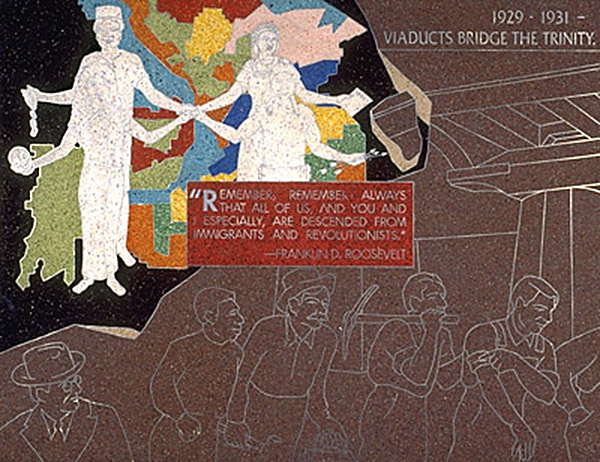
The monochrome mural in this piece is especially significant, because it alludes to the era and a political movement that made possible the Hogue/Bywaters project -- Franklin D. Roosevelt's The New Deal. The construction of the Trinity River viaducts (Houston, Commerce, Continental) were Works Progress Administration projects whose significance, beyond their economic impact, was the linking of Oak Cliff to downtown. The union of workers from all races is represented in Hogue and Bywaters' artwork. Franklin Roosevelt is in the lower left corner.

The importance of uniting the city is carried further in the color mural, which represents the coming to power of minority citizens of Dallas, most recently by the federally mandated redistricting of City Council districts, shown in the background. Four cultures are represented, each holding objects that symbolize darker days of their past: A black man holding chains (slavery), an Hispanic woman with a deed for land (loss of Texas by Mexico), a Southeast Asian woman holding a human skull (killing fields of war), and an American Indian with arrows (loss of native lands).

The quote is from Franklin Roosevelt: "Remember, remember always, that all of us, and you and I especially, are descended from immigrants and revolutionists."
Panel Eleven

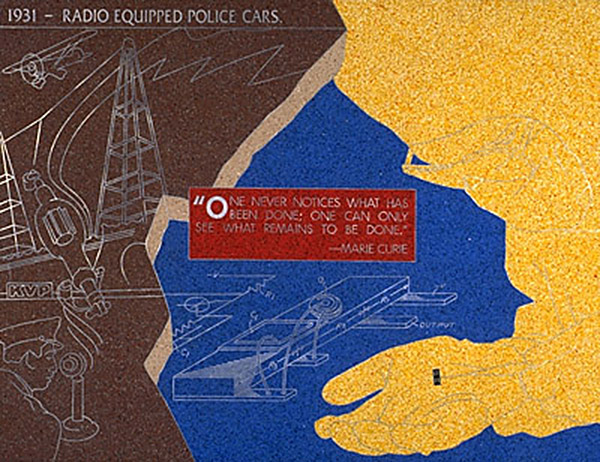
This was the last mural of the Hogue/Bywaters series, and is the most contemporary. It represented the Dallas Police Department's fleet of radio equipped cars. The technology was made possible by the electronic vacuum tube.

A significant parallel event in Dallas was the invention of the integrated circuit by Jack Kilby of Texas Instruments in the 1950's. His original patent drawing is shown in the center of the artwork. A technician in a "clean suit" examines a microchip of the 1990's containing hundreds of integrated circuits.

Marie Curie is quoted in the center: "One never notices what has been done; one can only see what remains to be done."
Panel Twelve

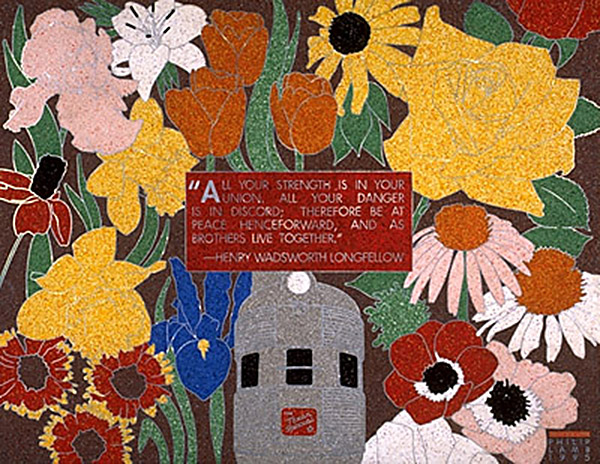
All the original City Hall murals having been shown, this full-color panel wraps up the series of twelve Union Station artworks. Very simply, it shows a caboose -- the end of the line, surrounded by abundant, beautiful flowers, some native Texas wildflowers. The train car is from a passenger line that rode through Union Station called "The Texas Special." In a final allusion to "union" -- the early converging of passenger trains at Union Station, the union of old murals and new information, the union of DART light rail with Amtrak at Union Station -- the final quote states "All your strength is in your union. All your danger is in discord. Therefore be at peace henceforward, and as brothers live together." It is from Henry Wadsworth Longfellow.

homeTheater
Theater

The Mystery of Edwin Drood set rental

In 1994, Mr. Lamb received a commission from DART to design and produce 12 murals to be displayed in wind screens on the light rail platform of the Union Station light rail platform, downtown Dallas. They are each 4 by 5 feet in size, and are executed in terrazzo.

Please scroll the page for images and descriptions
of the panels.

Panel One

This panel serves, in part, as a "legend" for the eleven other murals. It establishes a visual format in which past information, depicted in monochrome, is embellished and expanded with more recent information, shown in color. In each panel, the monochrome layer gives the illusion of "breaking away" to reveal a second image behind it. This dual format is combined with a third layer, a red rectangle in the center of each mural. The rectangles contain quotations that enrich the visual imagery.

The first panel explains the project's genesis. In 1934, Alexandre Hogue and Jerry Bywaters, two respected and accomplished Texas artists, painted ten murals in the old Dallas City Hall. The murals were destroyed in 1954 when the building was renovated and expanded. 

The next ten murals each depict Philip Lamb's interpretation of one of the Hogue/Bywaters murals, shown in monochrome, and are augmented with Mr. Lamb's full-color images that relate to the original mural subjects. The twelfth and final panel is a summation of the project. 

The monochrome drawing of Panel One depicts Dallas City Hall circa 1934. Below and to the right is a color representation of Union Station in 1995. To the left are three trains representing three generations of rail transportation in Dallas -- a steam engine, a diesel engine, and a DART light rail car. In the sky shown in the upper-right of the piece, seven lines converge into one that winds through the center of the image and overlaps the trains. This represents the function of Union Station when it opened in the early 1900's, to unite seven separate passenger rail stations into one. Symbolically, it represents the union of the Hogue/Bywaters murals with the updated imagery. The quote in this panel reads: "In 1934, Alexandre Hogue and Jerry Bywaters produced ten murals for Dallas City Hall. In 1956, they were destroyed. In 1995, here at Union Station, those murals live again, augmented, enhanced, elaborated." 

Panel Two

The Hogue/Bywaters mural shows John Neely Bryan, the founder of Dallas, building his log cabin. The original cabin remains preserved in downtown but at a different site. The title above is the same as the one used on the original mural: "1841 - The beginning of Dallas. John Neely Bryan builds his cabin." (All the following Hogue/Bywaters murals also have titles.) Revealed behind the monochrome depiction is downtown Dallas circa 1995, showing the tallest building (NationsBank Tower), the Hyatt Regency Hotel and ReUnion Tower, and City Hall. On a whimsical note, the large coffee cup hovering over City Hall refers to John Neely Bryan's son Coffee, who died as an infant. Bryan's cabin was located next to a spring seeping from a bluff on the Trinity River. Even after levees were constructed in the 1930's, historical accounts indicate that the spring continued to flow. There is no evidence of it now. The quote in the center of the image is from Margaret Bryan, John Neely's wife: "We lived happily in that lonely log hut. We ground our meal on a steel mill and raised the corn on the ground where your fine courthouse now stands."

Panel Three

The top half of this panel shows the Hogue/Bywaters mural of a commercial venture for crossing the Trinity River, Cockrell's Ferry. The title reads: "1850 - 1860 - Early Settlers - Cockrell's Ferry." The ferry was operated by Sarah Cockrell after the death of her husband. The artwork shows the Trinity River in a flooded state. Below the old mural, the new imagery shows the latest commercial crossing of the Trinity, the DART light rail bridge connecting Oak Cliff to downtown Dallas. The river is also shown flooded. The quote, from early Dallas resident Telitha Smith McDermett, also relates to crossing the river: "The first time I crossed we walked over on stones at the 'ford' below the ferry. Just where the ferry was, the old piers that supported the bridge before it fell still stood in the stream." This refers to an original bridge that collapsed, necessitating use of the ferry.

Panel Four

The Hogue/Bywaters mural shown in this panel refers to the La Reunion colony of French settlers that attempted an utopian community in the Dallas area. The image portrays a trade-day where the French settlers are exchanging goods with other area residents. The title reads: "1860 - 1870 - A Frontier Trades Day. French Immigrants Arrive." This utopian village, located approximately at where Highway 80 and Loop 12 intersect (it resembled their part of France) unfortunately failed. The crops were planted in infertile and rocky soil and fell victim to the now famous Texas summers. There were also disputes among the colonists. A parallel to this disaster is represented by the tornado in the background to the right, symbolizing the major tornadoes in the 1950's (Oak Cliff) and 1980's (Lancaster). The foreground shows the present-day Dallas trade area -- Farmers Market -- looking to the south (toward Oak Cliff and Lancaster). The quote in the center reads "O'liberte sois notre guide, fraternite soir notre soeur, vivant en paix sous votre eyeux, nous benirons le createur." Translated from a La Reunion song verse, it says "Liberty be our guide, friendship be our sister, live in peace in your eyes, our benevolent creator." Incidentally, the commercial development built in the late 1970's surrounding Union Station, ReUnion, was named in reference to this French colony.

Panel Five

The monochrome portion depicts the dedication ceremony for the arrival of the first passenger train in Dallas, in 1872. The man seated to the left of the orator is an aged John Neely Bryan, the founder of Dallas. The station was near the Deep Ellum section of Dallas, where Central Expressway now passes through. Central Expressway was constructed in the late 1940's on this railroad access. At the time, the station's location was considered to be quite a distance from downtown Dallas. The mural title reads "1870 - 1880 - H&TC railroad reaches East Dallas in 1872."

The color mural on the left shows Dallas North Tollway, another important transit route in Dallas history. Its first phase was completed in the late 1960's. An unintended consequence of its construction was the cleaving in two of the historic section of town called "Little Mexico." Little Mexico was already losing much of its importance as a community as Hispanics assimilated into all of Dallas. Construction of the Tollway was considered the death knell for the neighborhood. The heart of Little Mexico is Pikes Park, the centerpiece of which is a handsome arched building. In the mural, the building represents Little Mexico as wedged between the roadways of the Tollway. The building is shown as it was originally constructed. The quote: "El que da razon del camino es que andado lo tiene," is a Mexican proverb in an antiquated form of Spanish. It translates to: "He who travels the road knows it best." This translation is from a book of quotations in the Dallas Public Library, and its accuracy is questioned by some observers.

Panel Six

The Hogue/Bywaters mural on the left pictures the young and prosperous Dallas of the 1880's. The first Dallas City Hall is shown in the background. It was an elaborate brick structure. In the foreground is Dallas' first mass transit -- a mule-drawn trolley on tracks. The original mural is entitled "1880 - 1890 - The young city puts on airs."

Juxtaposed with this is an Interurban car from the system that operated in the Dallas area until the early 1950's, when the automobile became prevalent. During the Interurban heyday, one could catch a trolley in Downtown Dallas and go all the way to Sherman, Texas, for example. The system extended in all directions, covering many, many miles. It was the last rail system in Dallas until the present DART light rail system. The map below the Interurban car comes from the magazine of the Dallas Chamber of Commerce, published in the 1920's, and shows the elaborate extent of passenger rail routes at that time. The quote, from Dallas historian John H. Cochran, reads: "They had lived to witness and realize the success of their most sanguine hopes, which was impossible, unless the city and county had so rapidly improved."

Panel Seven

This panel is about the darkest day in the history of Dallas -- the assassination of President John F. Kennedy. On first observing this artwork, one struggles to see the connection of the old mural to the new information.

The Hogue/Bywaters mural, entitled "1890 - 1900 - Artesian well gushes on the courthouse grounds," shows a water well shooting a geyser. A man holds an umbrella upright. The assassination scene also shows a man raising an umbrella -- the famous "Umbrella Man" linked to the assassination by many conspiracy theories. Before hearing the Umbrella Man's testimony to the Senate Select Committee investigating the assassination, theorists assumed his raising of the umbrella was a signal to the gunmen. In fact, it was the man's personal protest of a particular Kennedy Administration policy. Artist Philip Lamb is depicted as the Umbrella Man in this mural. The assassination scene shows the motorcade just after it turned from Houston Street onto Elm, and in front of the now infamous Texas Schoolbook Depository.

The detail shows President and Mrs. Kennedy.

The quote, "Shall we deal adequately with the future or be run over by it," is attributed to then Mayor Erik Johnsson. It was drawn from a speech Mayor Johnsson made outlining his urban planning program called "Goals for Dallas." This initiative was a direct reaction to the negative publicity and damaged self-image of Dallas following the assassination. Goals for Dallas proposed civic projects for the future, among them the Dallas/Fort Worth International Airport.

Panel Eight

This mural, dated 1907, was a tribute to George Kessler, an early city planner. With a heading "1907 - The vision of George E. Kessler guides the hand of the engineer in planning the orderly city," the artists dedicated this work to "The Kessler Plan," one of the first master plans for the City of Dallas. It was within his plan that Kessler recommended Union Station be built. In addition, the Turtle Creek corridor was his idea, as much for flood control as it was for beautification. Kessler Park in Oak Cliff bears his name. The quote comes from the Kessler plan: "It is recommended that a Union Station be built. The several blocks immediately fronting it should be converted into an open plaza, giving to Dallas a dignified and worthy railroad entrance." That plaza is the existing Ferris Plaza.

The image in color shows Dallas/Fort Worth International Airport, yet another major transportation gateway recommended within a city plan, the "Goals for Dallas" of the 1960's.

Panel Nine

The mural on the left was the eighth in the Hogue/Bywaters series in City Hall. It commemorated of the construction of the dam for Lake Dallas. Lake Dallas then augmented White Rock Lake as a drinking water source for the city. It was titled "1924 - 1927 - Lake Dallas is completed."

To the right, the present-day is represented with what is also a major public works project -- the reconstruction of North Central Expressway. As represented in the lower center, during construction it was discovered that the old freeway and part of Lemmon Avenue covered Freedman's Cemetery, an African-American burial ground. Over a thousand citizens were discovered to be interred in that cemetery. The construction of this part of the freeway became a major political issue, resulting in a painstaking archeological excavation of the site and reinterment of the remains. A major public art project was commissioned for the site. The quote comes from one of only two tombstones discovered during the excavation: "How much of light, how much of joy, is buried with a darling boy."

Panel Ten

The monochrome mural in this piece is especially significant, because it alludes to the era and a political movement that made possible the Hogue/Bywaters project -- Franklin D. Roosevelt's The New Deal. The construction of the Trinity River viaducts (Houston, Commerce, Continental) were Works Progress Administration projects whose significance, beyond their economic impact, was the linking of Oak Cliff to downtown. The union of workers from all races is represented in Hogue and Bywaters' artwork. Franklin Roosevelt is in the lower left corner.

The importance of uniting the city is carried further in the color mural, which represents the coming to power of minority citizens of Dallas, most recently by the federally mandated redistricting of City Council districts, shown in the background. Four cultures are represented, each holding objects that symbolize darker days of their past: A black man holding chains (slavery), an Hispanic woman with a deed for land (loss of Texas by Mexico), a Southeast Asian woman holding a human skull (killing fields of war), and an American Indian with arrows (loss of native lands).

The quote is from Franklin Roosevelt: "Remember, remember always, that all of us, and you and I especially, are descended from immigrants and revolutionists."

Panel Eleven

This was the last mural of the Hogue/Bywaters series, and is the most contemporary. It represented the Dallas Police Department's fleet of radio equipped cars. The technology was made possible by the electronic vacuum tube.

A significant parallel event in Dallas was the invention of the integrated circuit by Jack Kilby of Texas Instruments in the 1950's. His original patent drawing is shown in the center of the artwork. A technician in a "clean suit" examines a microchip of the 1990's containing hundreds of integrated circuits.

Marie Curie is quoted in the center: "One never notices what has been done; one can only see what remains to be done."

Panel Twelve

All the original City Hall murals having been shown, this full-color panel wraps up the series of twelve Union Station artworks. Very simply, it shows a caboose -- the end of the line, surrounded by abundant, beautiful flowers, some native Texas wildflowers. The train car is from a passenger line that rode through Union Station called "The Texas Special." In a final allusion to "union" -- the early converging of passenger trains at Union Station, the union of old murals and new information, the union of DART light rail with Amtrak at Union Station -- the final quote states "All your strength is in your union. All your danger is in discord. Therefore be at peace henceforward, and as brothers live together." It is from Henry Wadsworth Longfellow.
homeTheater
Theater